Puerto Vallarta Buses
No route numbers, no timetables, no app — and still the easiest way to move up and down the bay.
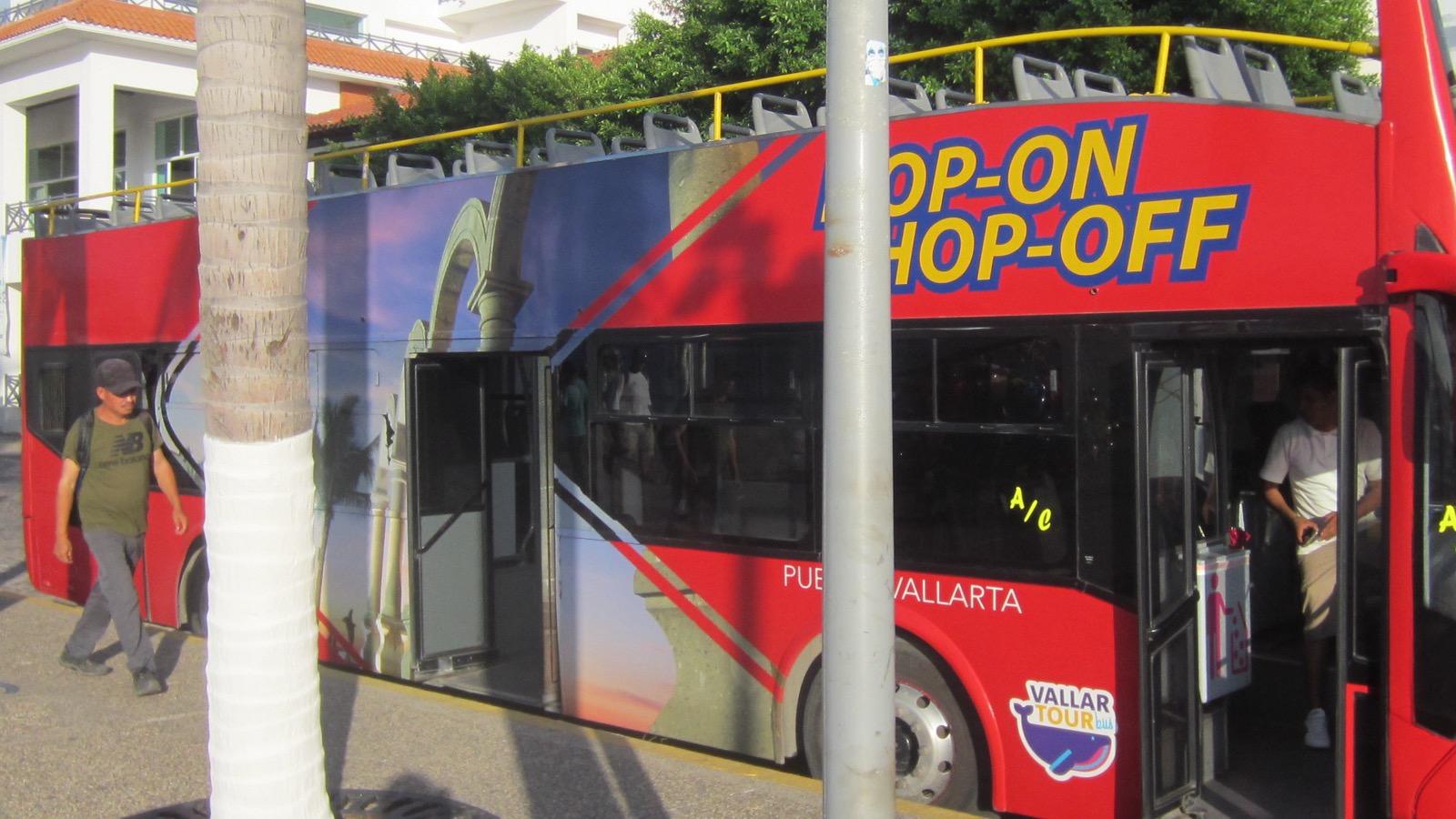
_-_104.jpg)
Puerto Vallarta's city buses are the cheapest way to get anywhere, and they confuse visitors for one reason: there is no map, no timetable and no app. Once you understand that the system runs on the windscreen rather than on paper, it becomes very easy. This page explains how to actually use one.
Read the windscreen, not a route number
Buses do not advertise a line number you could look up. Instead, the destinations they serve are painted or placarded across the top of the windscreen — place names and landmarks such as Centro, Marina, Hoteles, Aeropuerto, Pitillal, Ixtapa. You read the glass, find your destination, and get on.
The practical consequence: know the name of where you're going, not a number. If you want the Hotel Zone, look for Hoteles. For Marina Vallarta, look for Marina. For downtown, look for Centro. If you can't see your destination, ask the driver — saying the place name with a questioning tone is enough.
Where to catch one
Most city buses run the coastal road, the single artery that links the whole bay. There are marked stops, but drivers will also pick up where it's safe to do so if you put your arm out. Stand where you can see the traffic coming, make eye contact, and signal clearly — buses will not stop for someone standing passively on a kerb.
Heading north (towards Centro, the Hotel Zone, the Marina and the airport), you want the seaward side of the road going that way; heading south towards Old Town, the other side. This sounds obvious and is the single most common mistake visitors make.
Paying
- Cash, to the driver, as you board. There are no tickets to buy in advance and no cards.
- Carry small notes and coins. Drivers make change, but handing over a large note for a fare of a few pesos is not appreciated and sometimes not possible. See money & tipping.
- One flat fare per ride, regardless of how far you go within the city. Buses crossing into Nayarit charge more.
- No transfers. Changing buses means paying again.
Getting off
There is usually a buzzer, a cord or a button near the doors — press it a little before your stop. If you can't find one, "¡Baja!" (getting off) called clearly works and is what locals do. Buses stop briefly, so be standing and ready before it pulls in.
The routes that matter
| You want to go | Look for | Notes |
|---|---|---|
| Old Town ↔ Centro | Centro | Very short hop; walking the Malecón is often as fast and nicer |
| Old Town ↔ Hotel Zone | Hoteles | The workhorse route, constant service |
| Old Town ↔ Marina | Marina | Continues past the Hotel Zone |
| Towards the airport | Aeropuerto | Possible but awkward with luggage — see airport transfers |
| South to Mismaloya and Boca de Tomatlán | Mismaloya / Boca | The gateway to south-shore water taxis and the day trips |
| North to Nuevo Vallarta, Bucerías, Sayulita | Regional coaches, not city buses | Different operators, higher fare, cross the state line into Nayarit |
Going north into Nayarit
Buses to Bucerías, Punta de Mita and Sayulita are a different animal: regional coaches run by separate companies rather than city buses. They are still inexpensive and still cash, but they leave from set points north of the centre rather than being flagged down anywhere, and the ride to Sayulita takes roughly an hour. If you are heading up the coast for the day, budget for the journey being the slow part of the plan.
What riding one is actually like
Older buses are loud, warm and characterful; newer ones are air-conditioned. They can be crowded at commuter hours and the driving is brisk — hold on before the bus moves rather than after. Vendors and occasionally musicians board for a few stops. None of this is a problem; it is simply not the sanitised experience of a hotel shuttle, and it is a large part of why the bus is worth taking at least once.
When not to take the bus
- With luggage. There is no luggage space. Take a taxi or a transfer.
- Late at night, when service thins out and a taxi costs little.
- When you're in a hurry. Buses stop constantly; a taxi on the same route is much faster.
- In heavy rain during the green season, when the coastal road floods in places.
Sensible precautions
Buses are used by everyone and are not a high-risk environment, but they are crowded, which is exactly where opportunistic pickpocketing happens anywhere in the world. Keep your phone and wallet in a front pocket or a zipped bag rather than a back pocket, and keep your bag in front of you when standing. See is Puerto Vallarta safe? for the fuller picture.
Bus, taxi or Uber?
The bus wins on price and loses on speed and comfort. For a couple travelling together, the gap between a bus fare each and a short Uber is often small enough that the Uber wins on a hot afternoon. For a solo traveller going the length of the bay, nothing comes close to the bus. Getting around Puerto Vallarta compares every option side by side.