The Malecón
Puerto Vallarta's mile-long seafront boardwalk — sculptures, sunsets and the city's evening promenade.
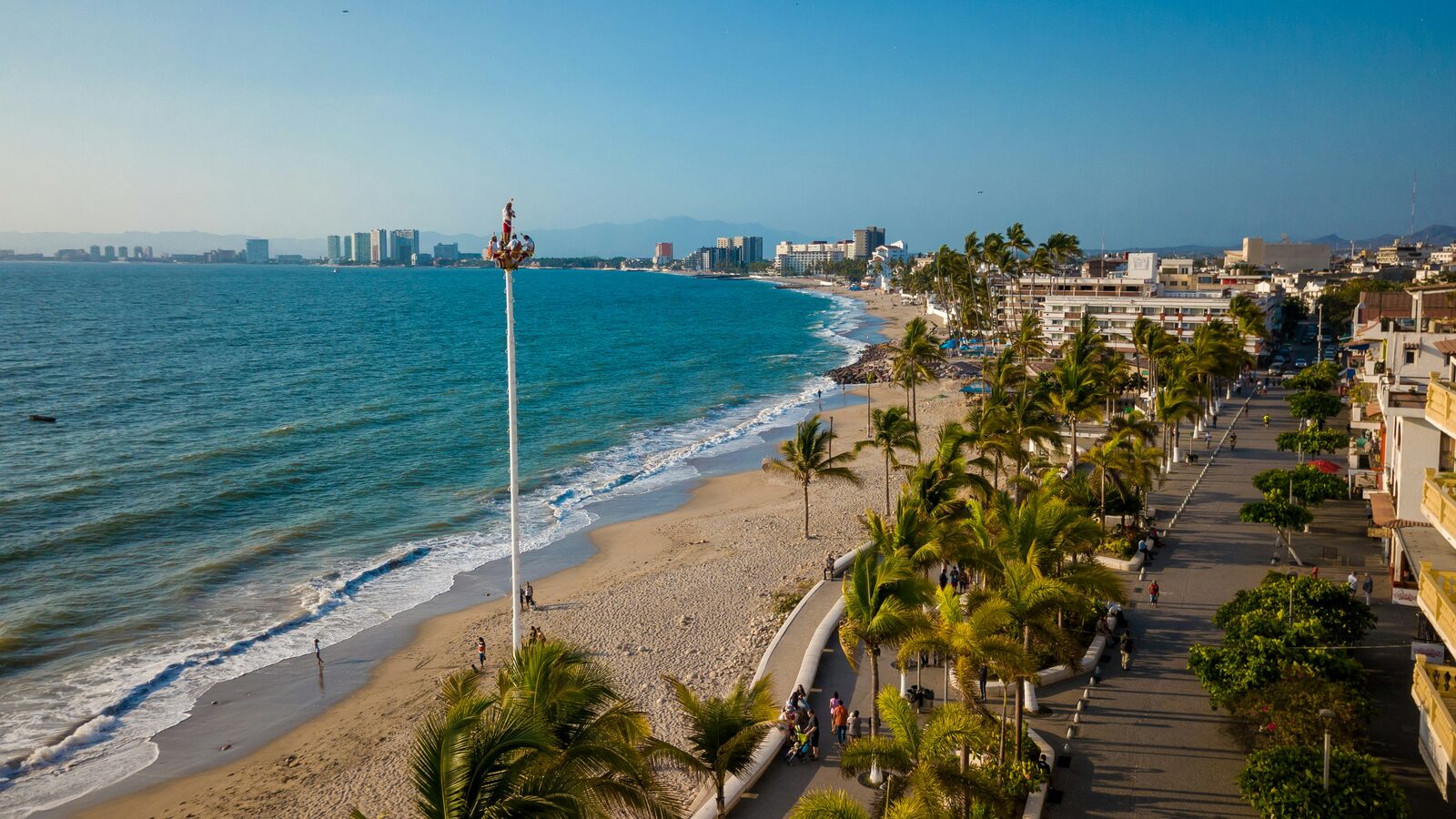
The Malecón is Puerto Vallarta's oceanfront boardwalk — a car-free promenade of about a mile along the downtown seafront, and the closest thing the city has to a communal living room. It's where locals and visitors walk, watch the sunset and gather in the evening.
Walking it end to end
The original Malecón runs for about 1.5 km — twelve blocks, roughly a mile — from the Hotel Rosita, at Calle 31 de Octubre, south to the Los Arcos amphitheatre by the main square. The promenade now carries on past the arches as a second stretch to the mouth of the Río Cuale, where a pedestrian bridge crosses to Olas Altas, the Los Muertos pier and Old Town. It's flat and easy, and often quicker on foot than a taxi through evening traffic.
The promenade itself is on one level, wide and smooth, with gentle ramps down to the beach, so it works for wheelchairs, scooters and pushchairs. Two cautions: at street crossings, pedestrians don't have right of way, so wait for the traffic; and the streets behind it climb steeply and are cobbled.
A short history
- 1930s–50s: the first seawall and promenade were built in 1935–36 and extended between 1940 and 1952. The Hotel Rosita at its northern end opened in 1948.
- 2002: Hurricane Kenna damaged the Malecón, destroyed the original Los Arcos and knocked over In Search of Reason. Both were rebuilt.
- 2011: a redesign by the landscape architects West 8, with Trama Arquitectos and Estudio 3.14, removed the road and rebuilt about 20,000 m² of promenade on a single, pedestrian-only level. It reopened in November 2011 with a 45-day festival. The pebble mosaics underfoot tell a Wixárika (Huichol) creation story, drawn by Fidencio Benítez and laid by local craftsmen under Amador Gómez Piña.
- 2024: a MXN 15.5 million programme repaired benches and mosaics and restored the big PUERTO VALLARTA letters.
- 2025: MXN 18.5 million of federal coastal-zone money paid for a further upgrade in two phases, including a facelift of the pedestrian bridge at the Río Cuale, which closed for the works in August. The city also approved an extension north from 31 de Octubre along Avenida México to Calle Argentina, joining Parque Hidalgo; work began in late October 2025, was briefly halted by protests, and we couldn't confirm it has been completed. Expect building work at the northern end.
The sculptures
The Malecón doubles as an open-air gallery, and the sculptures make natural stops as you walk. Several are meant to be touched and climbed on. This is the main set, listed roughly from the Hotel Rosita southwards, with the cross street nearest each one where the tourism board gives it:
| Sculpture | Artist, year | Near |
|---|---|---|
| Millennia (Los Milenios) | Mathis Lídice, 2001 | Hotel Rosita; the tall spiral at the northern end |
| Origin and Destination (Origen y Destino) | Pedro Tello, 2011 | Calle Allende |
| Nostalgia | Ramiz Barquet, 1984 | Calle Pípila; the second sculpture placed on the Malecón |
| The Subtle Stone Eater (El Comepiedras Sutil) | Jonás Gutiérrez, 2006 | Calle Josefa Ortiz de Domínguez |
| Erizados | Maritza Vázquez, 2006 | — |
| The Vallarta Dancers (Bailarines de Vallarta) | Jim Demetro, 2006 | A couple dancing in traditional dress |
| Unicorn of Good Fortune | Aníbal Riebeling-Gutiérrez, 2007 | Calle Leona Vicario |
| Nature as Mother (La Naturaleza como Madre) | Adrián Reynoso, 1996 | Calle Abasolo; the first interactive sculpture |
| Rotonda del Mar | Alejandro Colunga, 1996 | Calle Aldama; the circle of surreal seats you can sit on |
| In Search of Reason (En Busca de la Razón) | Sergio Bustamante, 2000 | Calle Corona; two figures climbing a ladder |
| Rain (Lluvia) | Jovian, 2020 | By the Malecón lighthouse, Calle Galeana |
| Triton and Mermaid (Tritón y Sirena) | Carlos Espino, 1990 | Calle Mina; for years mislabelled "Neptune and Nereida" |
| The Fisherman (El Pescador) | Ramiz Barquet, 1996 | A second cast stands on the Zona Romántica seafront |
| San Pascual Bailón | Ramiz Barquet, 2008 | — |
| The Boy on the Seahorse (El Caballito) | Rafael Zamarripa, 1976 | The city's emblem; first placed by Los Muertos and moved here in 2011 |
| Friendship Fountain | James "Bud" Bottoms and Octavio González, 1987 | North of Los Arcos; three leaping dolphins, a gift from Santa Barbara, California |
Landmarks along the way
- The Malecón lighthouse — the small white tower opposite Calle Galeana, first lit in 1932 and retired in 1970.
- Los Arcos amphitheatre — the arches at the southern end of the original Malecón, facing the main square. The originals were brought from a hacienda near Guadalajara in 1970, for a summit between Presidents Díaz Ordaz and Nixon; Hurricane Kenna destroyed them, and the replica you see, paid for by Zapopan and made by the sculptor Martín Distancia, went up in December 2002. Free concerts and folk dancing are held here.
- Plaza de Armas — the main square across the road, with its bandstand and a statue of the jurist Ignacio L. Vallarta, after whom the city is named. On Sunday evenings it turns into a dance floor for danzón.
- Church of Our Lady of Guadalupe — one block inland, under its crowned tower. The crown was damaged in the 1995 earthquake and replaced in 2009. In early December, the processions of the Fiestas de Guadalupe come down Calle Juárez to its doors. See downtown.
- City hall — on the main square; inside is a large mural of the city by the local painter Manuel Lepe.
Street life
From late afternoon the boardwalk fills with sand sculptors building elaborate tableaux, mimes and living statues, musicians and Huichol art vendors. The sand sculptors work for tips. The highlight for many is the Voladores de Papantla performing the Danza de los Voladores — the pole-climbing ritual dance in which four performers descend head-down on ropes from a tall mast by the seafront near the main square. In the high season they perform most evenings, usually between about 5 and 7 p.m.; there's no ticket, but tipping is expected and deserved.
When to go
Go in the late afternoon into the evening — the light is good, the heat drops, the performers come out, and the sunset over the bay is the point. Watch it from the seawall, then let it flow into dinner. Avoid the middle of the day: it's hot, there's almost no shade and it empties out. It is busiest, and at its best, during festivals, and on New Year's Eve, when the city holds a free party and fireworks here (see Christmas and New Year). The Wednesday Art Walk galleries are a few blocks inland. Keep phones and wallets close in the evening crowds.
Eating along it
Bars and restaurants line the inland side. Honestly, though: the seafront strip is the weakest dining in the city — convenient, touristy, priced for the view. Walk two streets inland, or cross into Old Town, and the food improves sharply. See where to eat.
Frequently asked
How long is the Puerto Vallarta Malecón?
The original Malecón is about 1.5 km — twelve blocks, roughly a mile — from the Hotel Rosita to the Los Arcos amphitheatre. The promenade continues past the arches to the Río Cuale, where a footbridge crosses to Old Town and Los Muertos.
What is the best time to visit the Malecón?
Late afternoon into the evening: the heat drops, the street performers come out and the sun sets over the bay. In the middle of the day it is hot, with little shade.
Where are the Malecón sculptures?
Spread along the promenade from the Hotel Rosita southwards, from the tall spiral of Millennia at the northern end to the Boy on the Seahorse and the Friendship Fountain near Los Arcos. Several are meant to be sat on or climbed.
Is the Malecón wheelchair accessible?
Yes. Since its 2011 redesign it is a single, pedestrian-only level, wide and smooth, with ramps to the beach. The streets inland are steep and cobbled.
When do the Voladores perform on the Malecón?
Most evenings in the high season, usually between about 5 and 7 p.m., by the seafront near the main square. There is no ticket; tips are expected.
Latest articles
Puerto Vallarta Transport Cost Estimator
What it costs to get around Puerto Vallarta and Banderas Bay — by bus, Uber, taxi or water taxi — with the…
Read →
Puerto Vallarta Trip Budget Calculator
Work out what your trip will cost — in total, per person and per day — from a guesthouse budget to a resort…
Read →
Puerto Vallarta Map
The city, the beaches, the boat-only coves and the towns around Banderas Bay on one map — each linked to its…
Read →